
By John Fortin, CSIA Level 3 instructor, CSIA Level 1 Course Conductor
“Yahoo! I passed my Level 3… the third try..”
Not a line that screams success. But it’s a line I’m comfortable sharing now—because my journey to Level 3 taught me far more about skiing, teaching, and myself than simply passing ever could have.
Like many candidates on the CSIA pathway, my first two attempts didn’t fall short because I couldn’t ski. I had put in the training.
We all know, ski conditions are whatever Mother Nature decides. You show up for the exam expecting the snow you trained on, and instead you get something different.
The kind of snow that gently reminds you of past experiences where things didn’t go your way.
Instead of skiing the way I had trained, my brain took over:
- Old mistakes
- “What if” scenarios
- The pressure of the moment
My breathing changed, body tightened and my focus drifted. Even though I knew I had the technical ability, I couldn’t access it when it mattered.
Looking back now, my skiing wasn’t the issue. It was my mind.
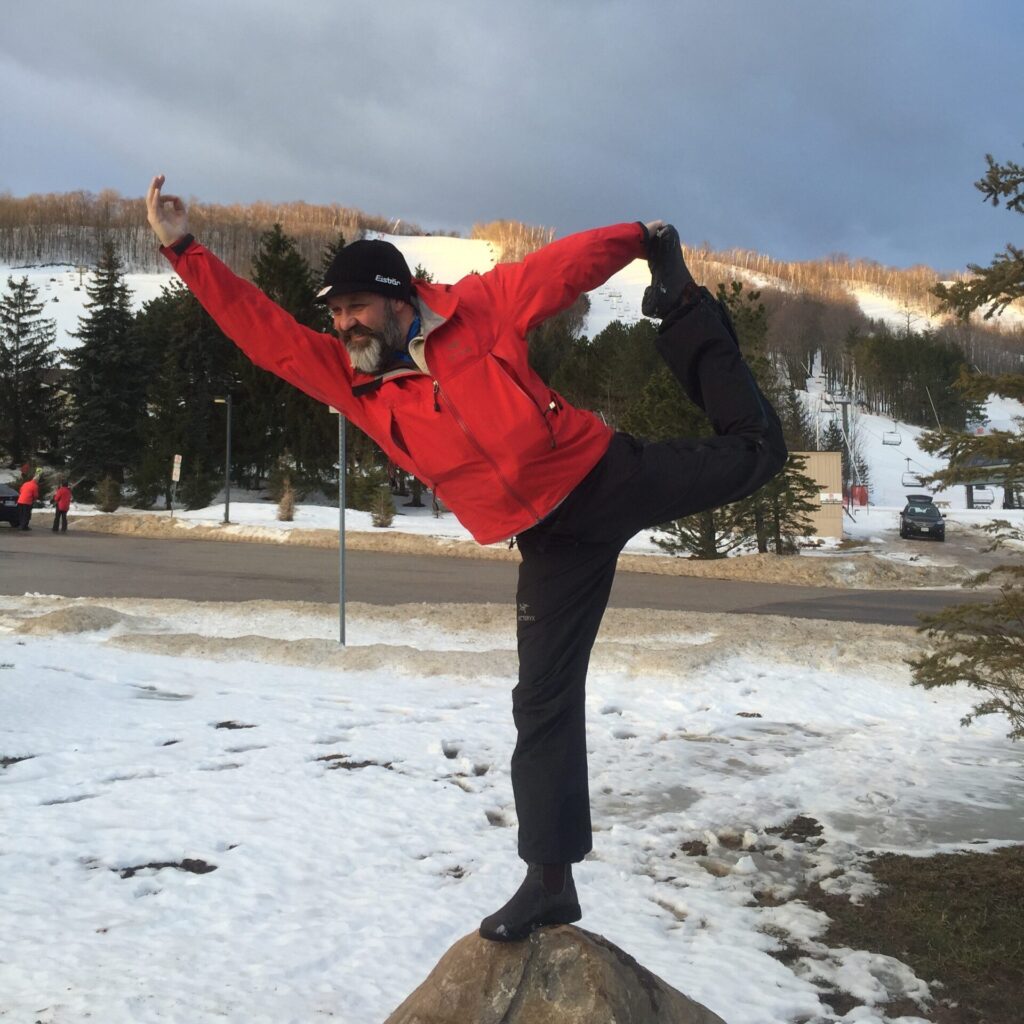
Around that time, yoga was already part of my life. What I hadn’t realized yet was how directly those practices could apply to skiing—especially under pressure.
Yoga didn’t suddenly transform my skiing through strength or flexibility. What it gave me was something far more valuable:
-Greater body awareness
-The ability to notice unnecessary tension
-An understanding of how breath affects focus and movement
-Awareness to recognize when my mind was distracted
Most importantly, it taught me that calm isn’t something that simply appears when you need it.
Just like skiing, its something you train.
The biggest difference between my first two attempts and my third was learning to be where I was, instead of where my mind wanted to go.
I became aware when my thoughts drifted toward past experiences or what if’s. I practiced bringing my attention back to the present moment.
Simple things grounded me:
- The feel of my feet in my boots
- The rhythm of my breath
- The flow of each turn
Along with training the technical elements of the exam, I practiced visualizing those movements in real time.
Instead of thinking, “This reminds me of last time,” I focused on the moment and the turn I was making.
That shift changed everything.
One of the simplest—and most effective—tools I used was my breath.
Nothing complicated. Just awareness.
Before starting, I would take a few full, conscious breaths. I made sure I continued breathing instead of holding tension. If I made a mistake, I used one slow breath to reset.
When I paid attention to my breath, my body softened.
When my body softened, my skiing flowed more naturally.
I stopped trying to force my skiing and started allowing it to happen.
By my third attempt, I recognized that training my mind was just as important.
Eventually, I accepted something that seems obvious in hindsight: I already had the technical ability.
I didn’t need to prove it, I just needed to do what I knew.
I just needed to trust my preparation.
Yoga and mindfulness helped me move out of my own way. Instead of skiing to pass an exam, I skied with intention and presence. That trust created space—to adapt, recover, and ski authentically rather than trying to match a perfect image in my head.
During my successful attempt, I used visualization in the same way it’s often used in yoga and mindfulness practices. Before tasks, I pictured calm, centered skiing. I visualized smooth movements and confident turns.
Instead of rehearsing fear or doubt, I rehearsed success.
Most importantly, I focused only on what I could control:
- My breath
- My focus
- My movements
Everything else faded into the background.
Looking back, my Level 3 journey taught me lessons that I continue to apply every day.
You can’t think your way into good skiing. At some point, you have to trust your body to do what it has been trained to do.
Calm is a skill, not a personality trait. Breath and awareness can be practiced just like edging, pressure control, or balance.
Conditions don’t define your ability—your response does. Snow is simply information. The story we attach to it is optional.
One breath can change an entire run.
And finally, mistakes don’t ruin performance—our reaction to them does.
If you’re heading into an exam—whatever level—here’s something I hope you carry with you.
If you pass, take the time to enjoy it. You earned it.
And if you don’t pass, it doesn’t define you as a skier or an instructor. It’s feedback. It’s part of the process. Sometimes the work isn’t about learning more—it’s about learning how to show what you already know when the pressure is on.
The exam will come and go.
But your growth, confidence, and love for skiing will continue long after.
Wherever you are on the journey, I wish you:
- Calm in moments of pressure
- Trust in your preparation
- Presence in your skiing
- And the patience to keep showing up
Pass or fail, you’re still on the path.