
By Alexandre Rocheleau, CSIA Level 3 Instructor and Level 1 Course Conductor, MHK, Certified Mental Performance Consultant CSPA/AASP
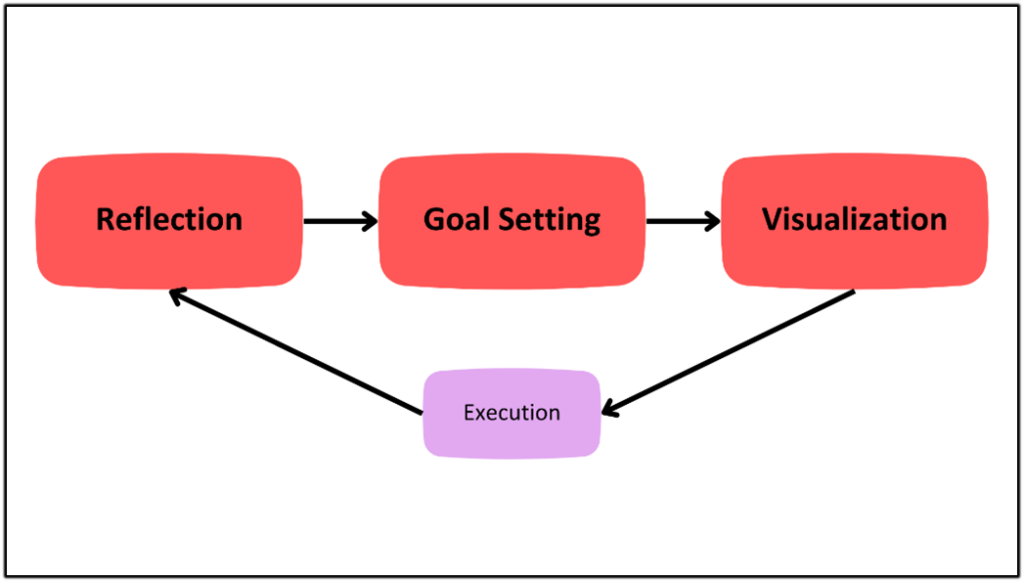
Preparing for a CSIA exam is demanding and time consuming: Instructors spend countless hours training, refining, and improving aspects of their skiing and teaching, all to be prepared to attempt their next level. Instructors dedicate significant time to physical and technical training – yet the mental side of preparation often receives less attention. In this article, we’ll look at 3 mental skills you can integrate within your training to guide your skiing exam preparation – reflection, goal setting and visualization.
Figure 1
Reflection
Reflection is a mental skill that facilitates the transformation of experience into learning. It can happen anywhere – on the chairlift, a safe location on the hill, or at home after your ski day. The intention is not to replay mistakes, or to simply state what was good and what was bad – It’s about evaluating your experience to establish the following: recognizing where you are, reflecting on what influenced your performance, and refocusing your efforts accordingly.
3 Rs: Recognize ➜ Reflect ➜ Refocus
Pro Tip: Keep reflections short and consistent. Going through the 3Rs should take no more than a minute: deliberate reflections don’t need to be long to be effective.
Goal Setting
When we talk about “refocusing” in the 3Rs of reflection, that is where the skill of goal setting begins to take effect – it answers the question “how do I refocus my efforts?”. Goal setting is the process of identifying meaningful, achievable outcomes and establishing the process goals to reach them. Since outcome goals are already predefined by CSIA levels evaluation criteria, this article will focus on how to set strong process goals. These are the short-term goals that direct you towards outcome goals.
Numerous goal-setting frameworks exist to support performers in setting meaningful goals, varying in both complexity and relevance to context. This article will present the AIM goals framework which fits well within the flow of a training day.
- A – Action-Oriented: State the goal clearly (ex. stretch the apex to build and maintain speed in long turns, start on 🟦 runs).
- I – Immediate: Keep it in the present, something you can apply today, not weeks from now.
- M – Measurable: Define what is success (ex. Start at 50% and gradually increase speed over 3 runs to reach 75% of expected exam pace).
Pro tip: Goal setting can be harder to apply effectively than it seems to be. Ensure you are being specific when setting goals with AIM.
Visualization
Once you’ve reflected and set your process goals, visualization comes into play as the skill bridging the gap between planning and execution. Visualization is the process of mentally rehearsing your performance by engaging your senses to simulate what you want to achieve. This skill makes your process goals come to life, as once you’ve identified your “AIM”, visualization lets you mentally experience success before physically executing it.
While visualization can entail a complex process, it’s possible to utilize it to quickly mentally rehearse your execution throughout your training day. The SEE framework acts as a strong guide to engage in the skill quickly and effectively.
- S – Set: Start by picturing your environment — the snow texture, temperature, slope angle, light level, etc… Engage your senses to make the image as vivid as possible.
- E – Execute: Mentally perform the action linked to your process goal. Focus on your measure of success and what needs to be done to find said success.
- E – Evaluate: Once concluded, evaluate – did you find success? Did anything feel rushed or unclear? If you don’t feel ready to execute physically, repeat visualization with the necessary adjustments.
Pro Tip: Keep it short and specific – 10-20 seconds is often enough! You don’t need to engage all 5 senses if it feels forced; start with sight and build from there. You can also try visualizing your execution from the third person to gain a different perspective on what you want to accomplish.
Once you’ve executed your intention a few times, you now have a new experience, and the process repeats itself!
Hopefully, this 3-skill model brings more structure, focus, and intention to your CSIA ski exam preparation. While mental skills can’t make up for a lack of physical practice, they can play an important role in helping instructors prepare with clarity and purpose. This 3-skill model represents a small part of how mental performance can enhance learning and development. Various other mental skills such as focus, confidence, self-talk, and more, all have something to offer to assist instructors in becoming not only better skiers, but better teachers.
If you have any questions on the content, please feel free to email me at rocheleau.alexandre.consulting@gmail.com